<?xml version="1.0" encoding="utf-8"?><feed xmlns="http://www.w3.org/2005/Atom" ><generator uri="https://jekyllrb.com/" version="4.4.1">Jekyll</generator><link href="/feed.xml" rel="self" type="application/atom+xml" /><link href="/" rel="alternate" type="text/html" /><updated>2026-04-15T10:06:37+00:00</updated><id>/feed.xml</id><title type="html">/</title><subtitle>Research and teaching, mostly real estate finance, a bit of Big Data, ML, domain names, and a careful dose of proptech. University of Cambridge, Department of Land Economy.</subtitle><author><name>Thies Lindenthal</name></author><entry><title type="html">Talk: AI in the research process</title><link href="/talk-ai-research-process/" rel="alternate" type="text/html" title="Talk: AI in the research process" /><published>2026-04-15T00:00:00+00:00</published><updated>2026-04-15T00:00:00+00:00</updated><id>/talk-ai-research-process</id><content type="html" xml:base="/talk-ai-research-process/"><![CDATA[<p>AI is changing how research gets done — but for anyone looking in from the outside, it is hard to tell what is doing the work. The analogy that keeps coming to mind is weight loss drugs. People get results. But whether it was the jab or the gym is rarely obvious, and the distinction matters.</p>

<p>At yesterday’s <a href="https://e-creda.com/">ECREDA conference</a> in London, I tried to triangulate exactly this. Using real estate research as a testing ground, I explored how LLMs perform on research idea generation — varying domain knowledge and constraints, then scoring ideas for novelty and predicted citation impact. AI can expand the frontier of what gets considered. But the gym still matters.</p>

<p><a href="/talks/talk-ai-re-research/">Slides are available here.</a></p>]]></content><author><name>Thies Lindenthal</name></author><summary type="html"><![CDATA[AI is changing how research gets done. But like weight loss drugs, it's hard to tell from the outside whether the results come from the jab or the gym.]]></summary></entry><entry><title type="html">Updating plausibility</title><link href="/consistency/" rel="alternate" type="text/html" title="Updating plausibility" /><published>2026-03-20T00:00:00+00:00</published><updated>2026-03-20T00:00:00+00:00</updated><id>/consistency</id><content type="html" xml:base="/consistency/"><![CDATA[<p>A minor detail can be enough to spoil an entire paper or book for me. Often enough, I read an argument in a field I do not know well, and it unfolds with a kind of internal coherence that feels persuasive, even elegant, with each claim seeming to follow naturally from the last, so that I find myself inclined to accept it without much resistance.</p>

<p>Then, at some point, the author touches on something I <em>do</em> understand.</p>

<p>It is rarely a dramatic mistake; more often it is a small one, a claim that is just a little too neat, or a generalisation that overlooks something obvious, yet it is enough to unsettle the whole structure, because it makes me question not only that specific point but also the parts I had previously taken on trust.</p>

<p>A recent example is the idea that desk-based labour will stop being scarce (as argued here: <a href="https://sahajgarg.github.io/blog/cognitive-labor/">https://sahajgarg.github.io/blog/cognitive-labor/</a>), which strikes me as broadly plausible, since if cognitive work can be replicated or scaled, its scarcity, and therefore its value, should diminish.</p>

<p>The contrast offered is property, presented as something that remains scarce and therefore insulated from this shift.</p>

<p>But that does not quite hold, because while certain locations are indeed scarce, such as a house on Lake Zurich or a flat in central London, that scarcity depends heavily on where people need to be, rather than on any absolute shortage of habitable or even desirable places.</p>

<p>If work becomes less tied to location, that constraint begins to dissolve, and with it the concentration of demand, since there are many lakes, many cities, and many landscapes that are currently considered “out of reach”, not because they lack value, but because they sit outside existing commuting patterns. In that sense, property is not nearly as insulated as it first appears.</p>

<p>What unsettles me is not the specific oversimplification itself, but what it reveals about the argument as a whole, because if the part I understand does not hold up particularly well, it becomes difficult to assume that the parts I do not understand are any more robust.</p>]]></content><author><name>Thies Lindenthal</name></author><summary type="html"><![CDATA[Spoiler alert. A Friday afternoon rant.]]></summary></entry><entry><title type="html">An Affordability Revolution?</title><link href="/affordability/" rel="alternate" type="text/html" title="An Affordability Revolution?" /><published>2026-02-11T00:00:00+00:00</published><updated>2026-02-11T00:00:00+00:00</updated><id>/affordability</id><content type="html" xml:base="/affordability/"><![CDATA[<p>Link to paper: <a href="https://papers.ssrn.com/sol3/papers.cfm?abstract_id=3418495">A Housing Affordability Revolution?</a></p>

<p>We study housing affordability in seven European cities from 1500-2024, using nearly half a million rent observations linked to wages, quality, and inequality. Constant-quality real rents rose slowly, while housing quality improved substantially. The 1910s-1970s saw a “housing affordability revolution,” with rapid wage growth relative to rents, declining inequality, and large-scale housing policies. Yet expenditure shares increased, particularly among low-income households. We use a Stone–Geary framework to reconcile these facts: rising minimum housing standards steepen Engel curves, raising budget shares at the bottom even when rent-to-wage affordability improves. Prices are an incomplete guide to affordability when housing standards evolve.</p>

<p><img src="/assets/images/affordability-revolution.png" /></p>

<p>This figure plots the real rent index, the real wage index, and the implied “affordability” index (wages relative to rents) for a weighted average of Amsterdam, London, Paris, and the four Belgian cities in our sample, 1500–present.</p>

<p>Until the early twentieth century, real wages and rents moved broadly together, implying no sustained trend improvement in conventional rent-to-wage affordability. A marked divergence emerges only in the twentieth century: from the 1910s through the postwar decades, wages rose much faster than rents, generating large and persistent gains in rent-to-wage affordability. These gains largely plateaued in the late 20th century, as wage growth slowed and public investments in housing were rolled back, while housing consumption per capita continued to rise.  A natural interpretation of this figure is that affordability improved dramatically in the last century. However, that reading clashes with the dominant contemporary narrative in cities
around the world. Our paper shows how both can be the case.</p>]]></content><author><name>Thies Lindenthal</name></author><summary type="html"><![CDATA[New version of Working paper out: 500 years of rents, wages and housing standards show how housing became cheaper yet less affordable for many. Overall, housing standards have increased a lot, especially for the urban poor. That positive trend comes at a financial cost, though.]]></summary></entry><entry><title type="html">AI in higher education: Last Samurai vs Brain Rot</title><link href="/samurai/" rel="alternate" type="text/html" title="AI in higher education: Last Samurai vs Brain Rot" /><published>2026-01-27T00:00:00+00:00</published><updated>2026-01-27T00:00:00+00:00</updated><id>/samurai</id><content type="html" xml:base="/samurai/"><![CDATA[<p>Today, my colleagues and I had an in-depth discussion about how our teaching needs to evolve. We are painfully aware of two AI-related risks that sit at opposite ends of the spectrum: becoming AI Luddites, or drifting into the habits of the lazy AI slob.</p>

<p>The first risk is the AI-avoiding “Last Samurai”. This is the stance that treats AI use as inferior, even as a form of cheating, and therefore refuses to engage with it at all. For centuries, samurai culture revolved around mastery of swordsmanship, discipline, and personal honour. When firearms arrived in Japan, they were dismissed as inelegant and unworthy of a true warrior. Yet mass-produced guns quickly proved decisive. Samurai who clung to traditional mastery found themselves outpaced by armies that required less individual skill but delivered far greater collective power. Their fundamentals were impeccable; the race had simply changed. The analogy extends to Amish communities in the US who, broadly speaking, chose to avoid technologies beyond the nineteenth century. In higher education, students who never learn to work with AI tools will be slower to achieve their goals, less competitive in roles where productivity is amplified by new tools, and will miss the chance to focus on areas where humans still have a clear edge over machines.</p>

<p>The second risk is the opposite: <strong>Skill atrophy</strong> (or, a bit more graphic, <strong>AI-induced brain rot</strong>). It is real, and it is already visible. Students can breeze through their education by outsourcing thinking, writing, and problem-solving to large language models. In doing so, they risk failing to develop core skills, resilience, creativity, and intellectual grit because the heavy lifting has been done for them. In this world, students struggle to draft and structure text. When fewer and fewer people can read complex texts, deep reading may become a new superpower in an age of shallow, AI-mediated summaries. Convenience slowly erodes competence, and fluency is mistaken for understanding.</p>

<p>The challenge for higher education is not to choose between rejection and surrender, but to navigate a narrow path between them. We need to teach students how to use AI deliberately and critically, while still demanding genuine thinking, effort, and originality. The goal is neither the honourable but obsolete samurai, nor the complacent passenger, but graduates who can wield new tools without letting those tools replace their minds. But how exactly can we achieve this?</p>]]></content><author><name>Thies Lindenthal</name></author><summary type="html"><![CDATA[Today, we had a discussion about how teaching needs to evolve in these AI enabled time. As researchers and educators we are painfully aware of two AI-related risks that sit at opposite ends of the spectrum: becoming AI Luddites, or drifting into the habits of the lazy AI slob.]]></summary></entry><entry><title type="html">Book in print: ‘Commercial Real Estate Analysis for Investment, Finance, and Development’</title><link href="/cre-book/" rel="alternate" type="text/html" title="Book in print: ‘Commercial Real Estate Analysis for Investment, Finance, and Development’" /><published>2025-12-22T00:00:00+00:00</published><updated>2025-12-22T00:00:00+00:00</updated><id>/cre-book</id><content type="html" xml:base="/cre-book/"><![CDATA[<p>The Geltner/Miller/Eichholtz book was probably the textbook that taught me the most… and the people behind it even more: Piet became my MPhil and PhD supervisor at Maastricht University, David was the key scholar and mentor during my postdoc at MIT and Norm guided my way into the Homer Hoyt Institute and ARES community. Now, more than a decade after the last update, the 4th edition of the book is finally in production, featuring my name among the authors (humblebrag).</p>

<blockquote>

  <h2 id="commercial-real-estate-analysis-for-investment-finance-and-development-"><a href="https://www.routledge.com/9781041081197">Commercial Real Estate Analysis for Investment, Finance, and Development </a></h2>

  <p>By David M. Geltner, Norman G. Miller, Alex Van De Minne, Piet Eichholtz, Thies Lindenthal, Lily Shen.</p>

  <p><img src="/assets/images/cre-4e.png" /></p>

  <p><em>Commercial Real Estate Analysis for Investment, Finance and Development</em>, a fully revised fourth edition of the authors’ leading textbook, presents the foundations of real estate investment analysis with the rigor of general finance and economics. This book introduces the essential building blocks of the field: market assumptions, valuation, financial analysis, and development. Drawing from extensive academic and industry experience, the authors approach the investment analysis process using a combination of theory and practical tools in a discussion tailored to advanced students.</p>

  <p>Topics include value concepts, mortgage analysis, financing alternatives, option value, leverage and risk analysis, as well as institutional and capital market trends. Additionally, the new edition addresses climate risks, alternative property types, and the impact of technology on real estate as an asset class. New supplemental online resources complement the book’s conceptual and quantitative study questions, chapter summaries, and other useful pedagogical features.</p>

  <p>Combining a practical grounding in economics and finance with updated tools and resources, this edition of Commercial Real Estate Analysis for Investment, Finance and Development provides a new generation of professionals the foundation and tools they need to excel as investment managers, advisers, and analysts. Ideal for graduate studies in real estate, finance, and business, this textbook prepares students for the real-world complexities and challenges of commercial real estate.</p>

  <p>For access to additional, online chapters and other Instructor and Student Resources, please visit: www.routledge.com/cw/geltner-miller</p>
</blockquote>

<p>We updated and streamlined the book: The first part (printed) gives a foundation in real estate finance that should nicely fit into a semester/term. The second part (online) allows for customisation with more specialised topics. This structure will hopefully be closer to the reality of how instructors have used the book in their courses – at least this is how I teach here in Cambridge. Importantly, the new format also brought the price down: With current discounts, it will cost £59 in the UK, which is less than what I paid 20 years ago (even in nominal terms!).</p>]]></content><author><name>Thies Lindenthal</name></author><summary type="html"><![CDATA[The fourth Edition of the Geltner et al. CRE textbook is finally in production. And the 'al.' now includes (Lindenth)al...]]></summary></entry><entry><title type="html">New Working Paper: Missing Data in Real Estate</title><link href="/missing-data/" rel="alternate" type="text/html" title="New Working Paper: Missing Data in Real Estate" /><published>2025-11-26T00:00:00+00:00</published><updated>2025-11-26T00:00:00+00:00</updated><id>/missing-data</id><content type="html" xml:base="/missing-data/"><![CDATA[<ul>
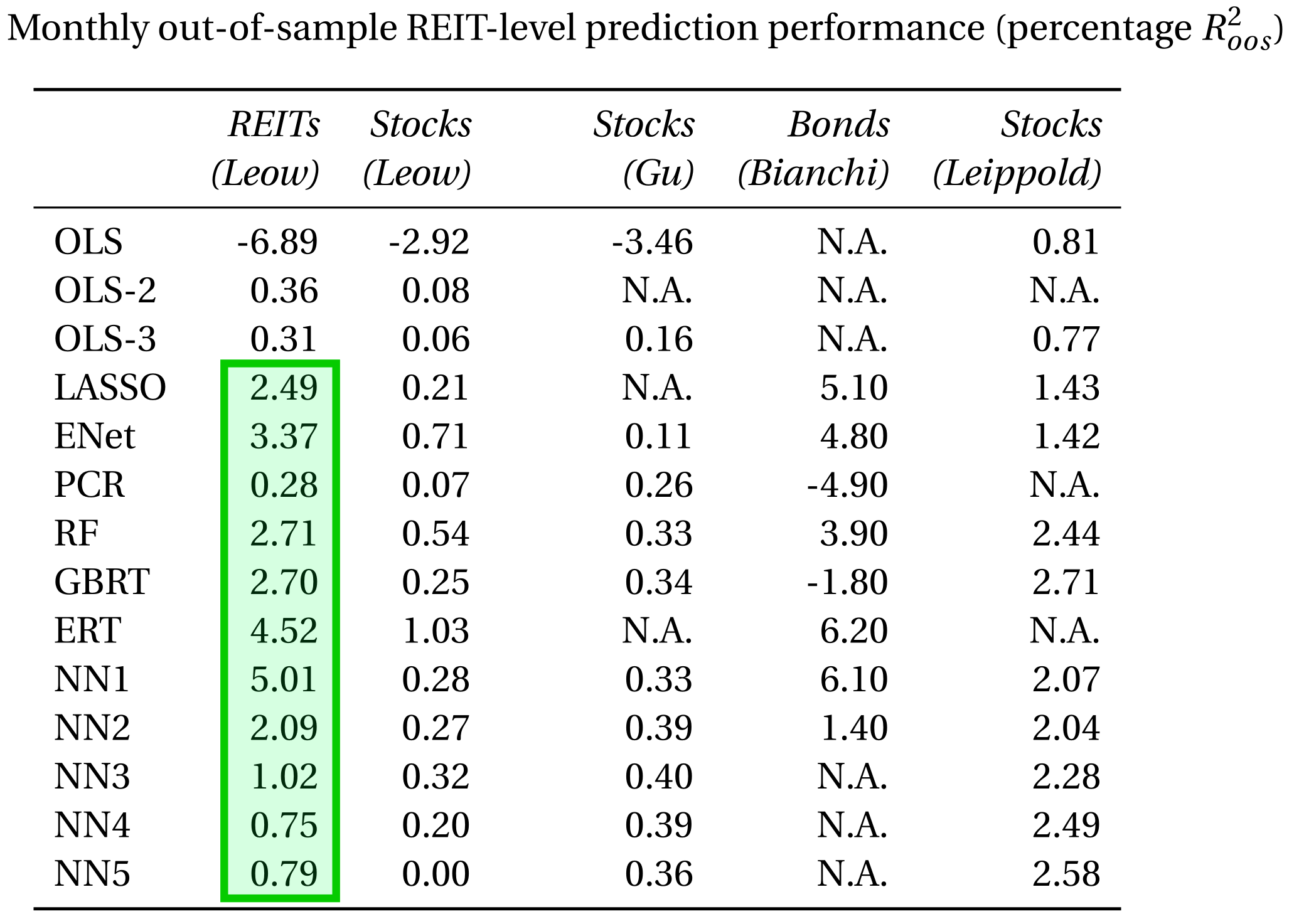
  <li>Leow, K. and T. Lindenthal. <a href="/assets/papers/Leow-Lindenthal-Leveraging-Missing-Data-in-Commercial-Real-Estate.pdf"><strong>“More Is More: Leveraging Missing Data in Commercial Real Estate with Machine Learning”</strong></a>
    <ul>
      <li>Missing data are pervasive in commercial real estate research, yet common practice remains to discard incomplete observations or fill gaps with crude imputation rules. We show that doing so can meaningfully distort inference and reduce predictive accuracy.  Using detailed asset-level data from the NCREIF Property Index, we document substantial and systematic missingness in key variables, suggesting that data are unlikely to be missing at random. We then demonstrate that modern machine-learning methods, specifically the sparsity-aware XGBoost algorithm, can exploit incomplete observations without requiring imputation, yielding markedly higher out-of-sample predictive performance than models restricted to complete cases. Moreover, we find that incorporating incomplete data can change the apparent marginal effects and relative importance of standard covariates, implying that conclusions drawn from ‘clean’ subsamples may be misleading. Our results highlight that, in commercial real estate applications, more data—even if partially missing—can be more informative than smaller, perfectly complete samples.</li>
    </ul>
  </li>
</ul>]]></content><author><name>Thies Lindenthal</name></author><summary type="html"><![CDATA[Missing data are pervasive in commercial real estate research, yet common practice remains to discard incomplete observations or fill gaps with crude imputation rules. We show that doing so can meaningfully distort inference and reduce predictive accuracy...]]></summary></entry><entry><title type="html">David Geltner on “Are We Losing Our Democracy?”</title><link href="/Geltner/" rel="alternate" type="text/html" title="David Geltner on “Are We Losing Our Democracy?”" /><published>2025-11-09T00:00:00+00:00</published><updated>2025-11-09T00:00:00+00:00</updated><id>/Geltner</id><content type="html" xml:base="/Geltner/"><![CDATA[<p>I have learnt so much from David Geltner over the last 20 years. First, there was his seminal <a href="https://www.routledge.com/Commercial-Real-Estate-Analysis-for-Investment-Finance-and-Development/Geltner-Miller-VanDeMinne-Eichholtz-Lindenthal-Shen/p/book/9781041076391">textbook</a>, then <a href="https://scholar.google.co.uk/scholar?hl=en&amp;as_sdt=0%2C5&amp;q=david+geltner&amp;btnG=">paper after paper</a> and many conversations during my postdoc years at MIT’s Center for Real Estate. And yesterday, when I read another example of his clear thinking and writing in response to <a href="https://www.nytimes.com/2025/11/08/opinion/trump-us-democracy-autocracy.html">an article in the New York Times</a>:</p>

<blockquote>
  <p><strong>To the Editor:</strong></p>

  <p>“Are We Losing Our Democracy?” is an important piece of journalism, but it raises yet another important question: Why is this happening now, after 250 years?</p>

  <p>To stop and reverse the autocratic slide, we must admit that our democracy was not actually working in the first place. For at least a decade before President Trump’s second term began, the federal government could not, with rare exceptions, get anything meaningful or important done and implemented.</p>

  <p>Even initiatives with clear popular support were often stalled by political polarization and extreme partisanship. A government of checks and balances requires compromise in order to function effectively.</p>

  <p>This paralysis happened not in a time of general satisfaction and well-being, but in a time of crises — of cultural identity, income inequality, information distribution — and a steep decline in the average American’s happiness and sense of security, for themselves and their children.</p>

  <p>For a society, this is a recipe for governmental change. Like it or not, President Trump has had a big impact on the direction of that change. But even without this president, we would need to find our way out of the crises and state of paralysis we’ve been in for too long.</p>

  <p>David Geltner <br />Carlisle, Mass.</p>
</blockquote>]]></content><author><name>Thies Lindenthal</name></author><summary type="html"><![CDATA[I have learnt a lot from David Geltner over the last 20 years.]]></summary></entry><entry><title type="html">Upside down?</title><link href="/shapes/" rel="alternate" type="text/html" title="Upside down?" /><published>2025-11-08T00:00:00+00:00</published><updated>2025-11-08T00:00:00+00:00</updated><id>/shapes</id><content type="html" xml:base="/shapes/"><![CDATA[<p><img src="/assets/images/coffeeandveg/carrot.png" /></p>]]></content><author><name>Thies Lindenthal</name></author><summary type="html"><![CDATA[This made me smile.]]></summary></entry><entry><title type="html">Old work: Demografische Krimp en Woningsprijzen</title><link href="/demografische-krimp/" rel="alternate" type="text/html" title="Old work: Demografische Krimp en Woningsprijzen" /><published>2025-10-21T00:00:00+00:00</published><updated>2025-10-21T00:00:00+00:00</updated><id>/demografische-krimp</id><content type="html" xml:base="/demografische-krimp/"><![CDATA[<p>Piet Eichholtz and I wrote this short piece on the impact of changing demographics on house prices many years back. Some people still ask me for a copy, so I finally scanned and uploaded it: <a href="/assets/papers/eichholtz-lindenthal-demografische-krimp.pdf">Demografische Krimp en Woningsprijzen</a></p>

<p>A short extract:</p>

<p><em>Voor Nederland als geheel neemt het aantal huishoudens nog steeds trendmatig toe, maar op termijn komt daar een eind aan. Volgens de meest recente projecties zal het aantal huishoudens in Nederland ergens in de jaren dertig stabiliseren, wat betekent dat in een deel van het land nog steeds groei zal plaatsvinden en in andere delen krimp. In die regio’s krimpt ook de vraag naar woningen en dat kan grote gevolgen hebben voor de prijzen op lokale woningmarkten. De afgelopen decennia werd de woningmarkt geken-merkt door consistente groei en het Nederlandse beleid was erop gericht om die groei in goede banen te leiden. De komende decennia zal Nederland wat dat betreft een draai moeten maken en gaan nadenken over de vraag hoe het woningmarktbe-leid moet worden aangepast als de groei regionaal omslaat in krimp. Dit is een urgent probleem omdat in Nederland enkele regio’s bestaan waar deze krimp nu al gaande is. Zeeuws-Vlaanderen en Groningen worden vaak genoemd, maar Parkstad Limburg is met circa 240.000 inwoners de belangrijkste en meest verstedelijkte regio waar de krimp al is begonnen. Parkstad (een samenwerkingsverband van de gemeenten Heerlen, Kerkrade, Landgraaf, Brunssum, Voerendaal, Simpelveld en Onderbanken) is in bevolkingsomvang de zesde stedelijke regio van Nederland, niet veel kleiner dan de regio Eindhoven. Door de demografische krimp en de verbreding van de hypotheekrenteaftrek naar huishoudens met een woning over de grens maar een inkomen in Nederland neemt de vraag naar woonruimte in Parkstad trendmatig af. De afgelopen jaren is de ontwikkeling in deze Limburgse regio deels gemas-keerd door de doorzettende groei in de Nederlandse woningprijzen, maar als de prijzen in Nederland stoppen met stijgen, zullen ze in Parkstad waar-schijnlijk gaan dalen. Dit alles betekent ten eerste dat er nu voor Parkstad nieuw beleid moet warden gemaakt en ten tweede dat de ontwikkelingen in deze stadsregio belangrijke lessen vormen voor de toekomst van de Nederlandse woningmarkt. De bedoeling van dit artikel is om de effecten van krimp voor lokale woningmarkten in kaart te brengen met behulp van de casus Parkstad…</em></p>]]></content><author><name>Thies Lindenthal</name></author><summary type="html"><![CDATA[Piet Eichholtz and I wrote this short piece on the impact of changing demographics on house prices many years back. Some people still ask me for a copy, so I finally scanned and uploaded it.]]></summary></entry><entry><title type="html">On Rejections</title><link href="/on-rejections/" rel="alternate" type="text/html" title="On Rejections" /><published>2025-10-08T00:00:00+00:00</published><updated>2025-10-08T00:00:00+00:00</updated><id>/on-rejections</id><content type="html" xml:base="/on-rejections/"><![CDATA[<p>I cannot say  I enjoyed this essay, but I recognised the turmoil of emotions following another rejection email: <a href="https://www.theguardian.com/lifeandstyle/2025/oct/08/stay-true-to-yourself-fly-closer-sun-what-ive-learned-from-50-years-of-rejection">‘Stay true to yourself – and fly closer to the sun’: what I’ve learned from 50 years of rejection</a> by Bob Brody.</p>

<p>I have not reached Bob’s enlightened state of mind, yet. But I hope I will, eventually. Rejections sting.</p>]]></content><author><name>Thies Lindenthal</name></author><summary type="html"><![CDATA[It happens so often, stings every time, and should not slow you down...]]></summary></entry></feed>