How AI shapes the research
agenda in real estate
finance and economics
Thies Lindenthal · University of Cambridge · 2026


Moving up the value chain...
Am I still useful in the research process? Does a human competitive edge remain?
Comparison of Core Research Competencies (my self-perception)
50 years of real estate research
6,255 papers (REE, JREFE, JRER, JUE, AER, JF, RFS) embedded and clustered into 78 research strands
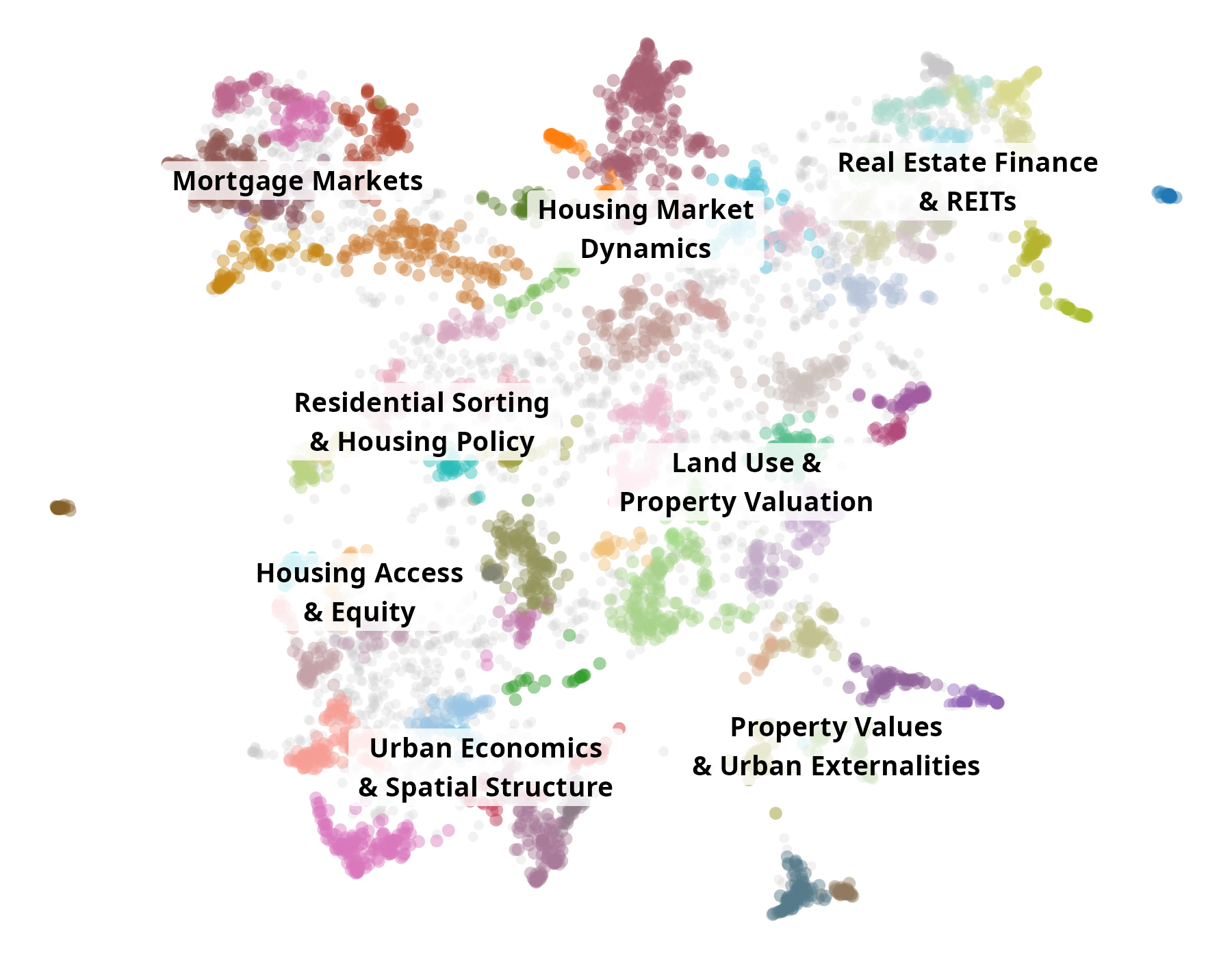
Where do AI-generated ideas land?
Each dot is a generated idea projected into the research space
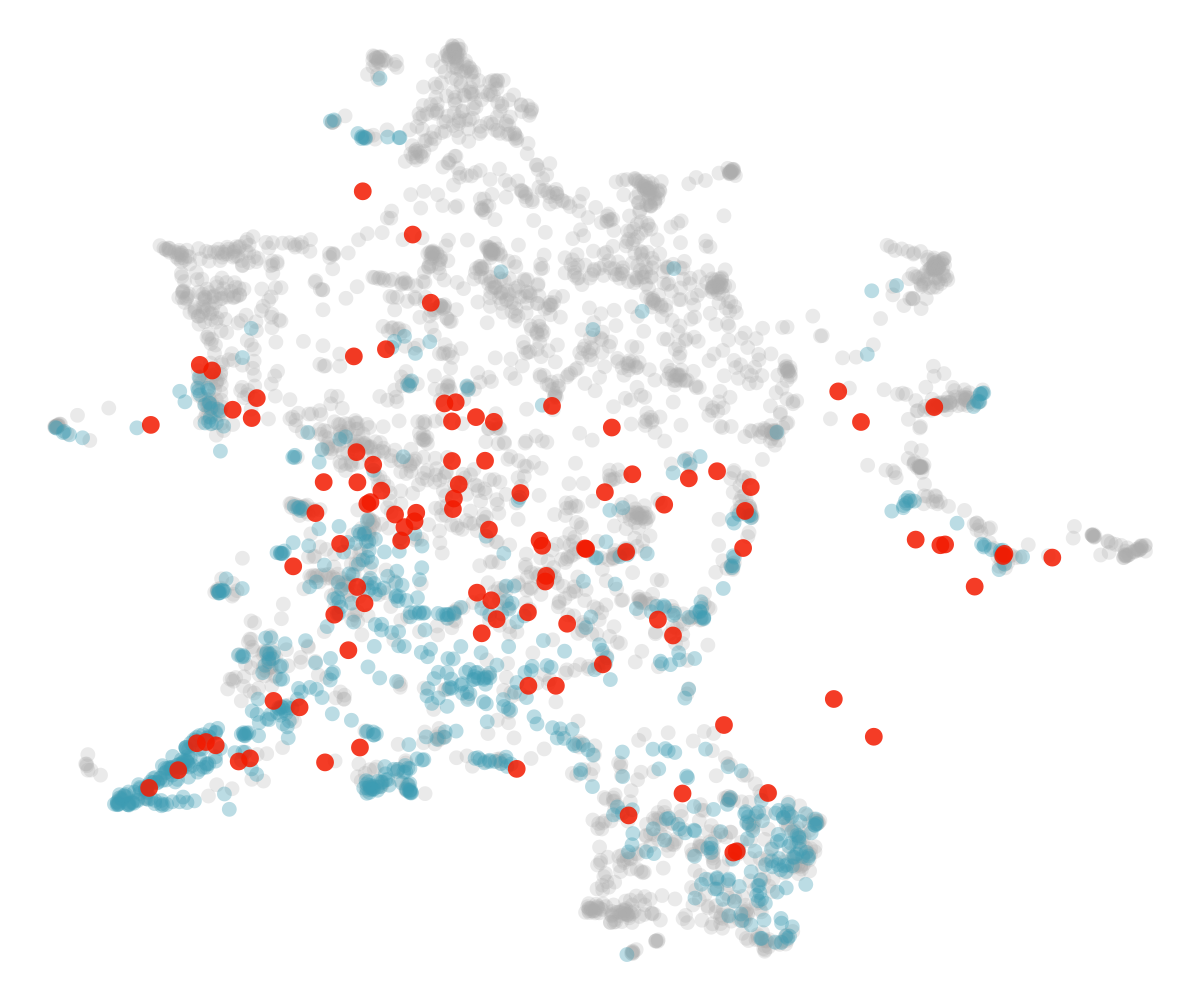 A: Naïve generation, based on LLM training only
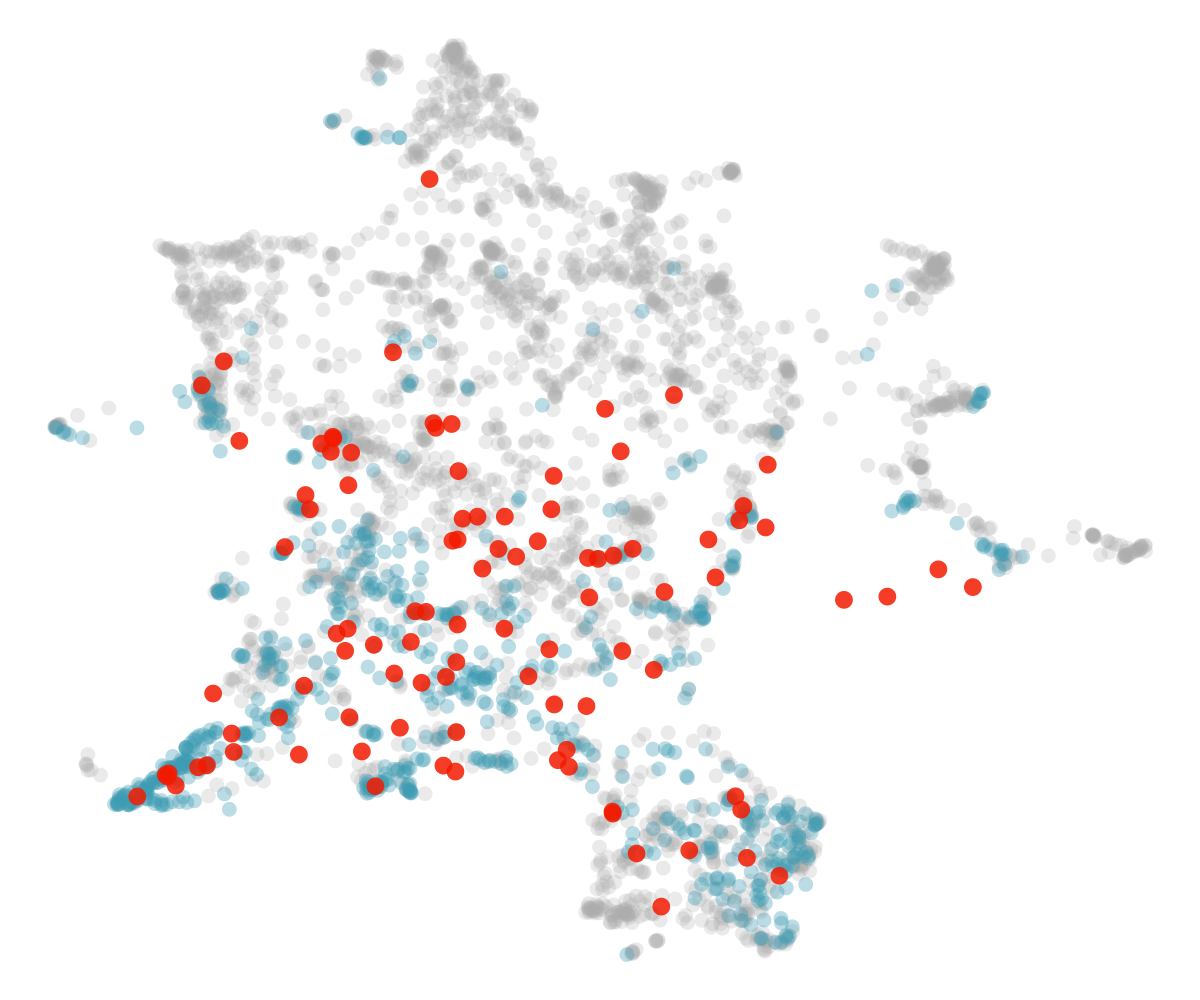 B: Full REE corpus provided as context
Where do AI-generated ideas land?
Cross-field transfer conditions
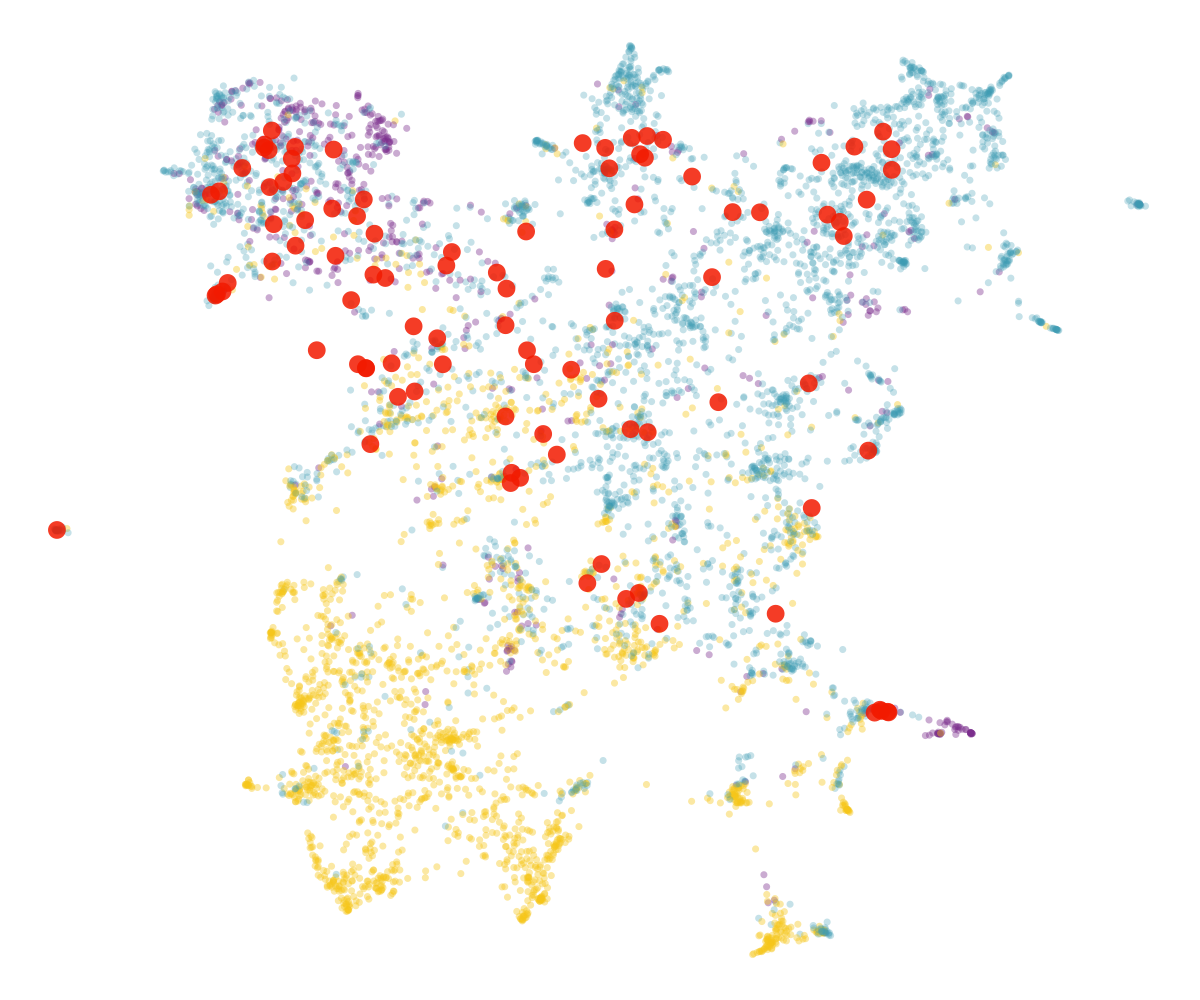 E: Paradigm transfer — question & design from Econ/Finance
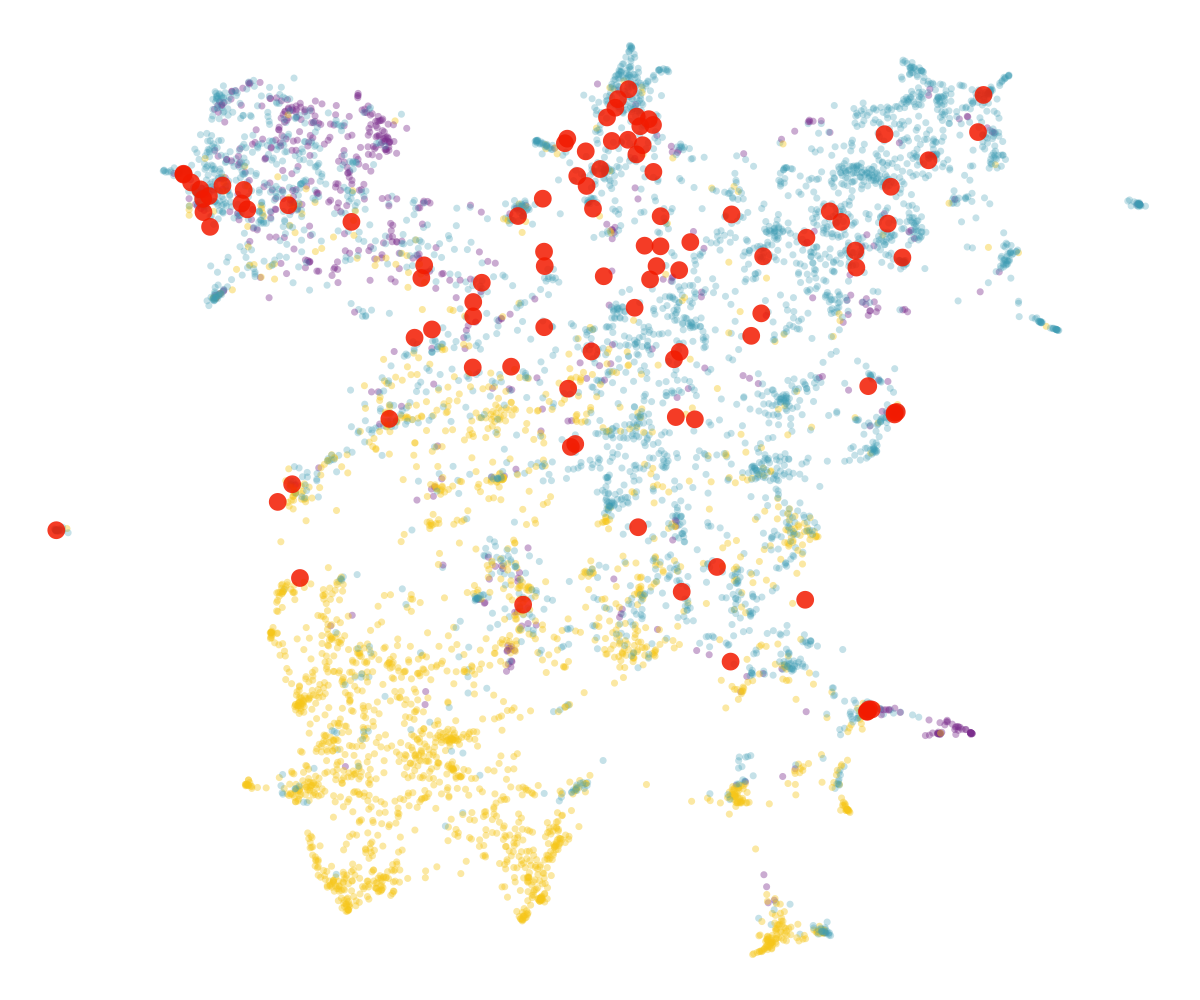 F: Paradigm transfer — question & design from Psychology (more concentrated, HHI ~4–5x baseline)
Comparing generated research ideas
Unconstrained variant; 100 ideas per condition-variant (4 runs × 25), pooled
| Condition | Clusters | HHI | Atypicality (mean ± SD) | Weak data | Frontier dist./RE (Periph.) | NN dist./RE |
|---|---|---|---|---|---|---|
| A — Naïve | 36 / 78 | 0.051 | 0.726 ± 0.214 | 10% | 3.52 | 1.14 |
| B — Full REE corpus | 35 / 78 | 0.044 | 0.772 ± 0.173 | 27% | 4.17 | 1.16 |
| C — Method trans. (econ/fin) | 30 / 78 | 0.065 | 0.745 ± 0.192 | 9% | 2.87 | 0.93 |
| D — Method trans. (psych) | 27 / 78 | 0.130 | 0.673 ± 0.238 | 35% | 2.65 | 1.09 |
| E — Paradigm trans. (econ/fin) | 29 / 78 | 0.073 | 0.729 ± 0.238 | 15% | 2.89 | 0.99 |
| F — Paradigm trans. (psych) | 31 / 78 | 0.145 | 0.682 ± 0.258 | 42% | 3.34 | 1.17 |
| RE corpus (baseline) | 70 / 78 | 0.030 | 0.594 ± 0.258 | — | 1.00 | 1.00 |
Weak data = share whose required data scores 0–1/3 on the structured post-hoc check. Constrained variant roughly halves this share but barely moves atypicality. Frontier dist./Periph. is the same cluster-centroid distance later entered (log-transformed) as "frontier distance" in the citation-prediction model.
Does atypicality predict impact?
Tested on 1,937 published papers — geometry loses to venue and cluster norms
| Predictor | Coef. |
|---|---|
| log(Age) | 0.747*** |
| Atypicality | −0.162 (n.s.) |
| NN distance | −0.194 (n.s.) |
| log(Frontier dist.) | −0.078*** |
| Cluster mean log-cit. | 0.679*** |
| Journal fixed effects | yes, all p<0.01 |
\( \log(1+c_i) = \alpha + \beta_1\log(age_i) + \beta_2\,atyp_i + \beta_3\,nn.dist_i + \beta_4\log(frontier.dist_i) + \beta_5\,\bar{c}_{k(i)} + journal.FE_i + \varepsilon_i \)
\(R^2 = 0.374\); \(n = 1{,}937\); 5-fold CV \(R^2 = 0.362\)
Citations are driven by venue and cluster citation norms, not by embedding geometry. Once controlled, atypicality and nearest-neighbour distance are not significant — so citation counts are the wrong yardstick for judging unpublished proposals. Atypicality remains a measurable ex-ante property, but its link to eventual scientific value is unvalidated here.